

GNSS anti-spoofing for ships. Know your position — and how far to trust it.
DIDI GNSS builds GNSS anti-spoofing into the receiver’s core position engine. Every fix carries a live Trust Score that warns the bridge before a false position reaches ECDIS.
First deliveries Q1 2027·Sea trials complete
Reserving takes under a minute. No payment, no commitment — it secures your place in the first delivery cohort.
A spoofed fix doesn't fail loudly — it lies quietly.
In the Baltic, the North Sea, the Black Sea, the Eastern Mediterranean and the Gulf, GNSS jamming and spoofing are now a daily reality — and a standard receiver cannot tell the bridge when to stop trusting it.
- A spoofed fix looks clean — the receiver reports no error, but the position is fabricated
- The false position flows into ECDIS, AIS and autopilot with no warning on the bridge
- Incidents go undocumented, leaving no evidence for insurers or port authorities
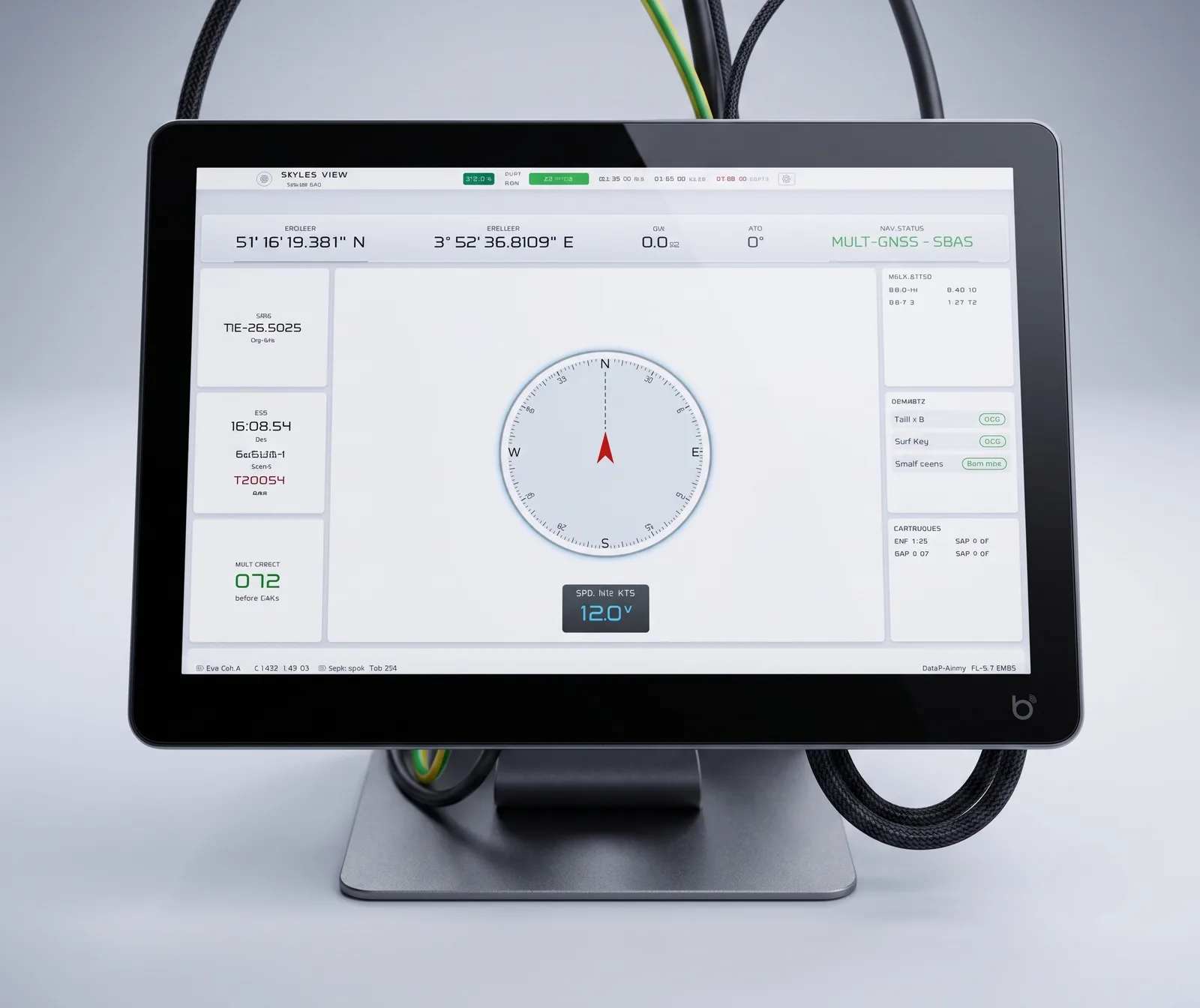
GNSS anti-spoofing, engineered into the core.
DIDI GNSS is not a monitor bolted onto a standard receiver. Anti-spoofing is built into its core position engine, so it does not just report where you are — it tells the bridge how far that position can be trusted.
YOUR GPS IS LYING. Would your bridge know?
Thirty-four seconds on how spoofing slips past a standard receiver — and what DIDI GNSS shows the bridge instead.
What it changes on the bridge
Precise positioning
Up to 20 cm without external correction data — accuracy that holds when conditions get difficult.
Live Trust Score
A live 0–100 confidence value on every fix — an early warning before a false position misleads the watch.
Signal authentication
Cryptographic verification of the navigation signal exposes forged satellites at the source.
Anti-jam & anti-spoof
Interference resistance engineered into the core position engine — not a filter applied afterwards.
The engineering underneath
- Position accuracy: up to 20 cm, without external correction data
- Live Trust Score: 0–100 on every fix (Spoof / Caution / Trusted)
- Multi-GNSS engine: GPS, GLONASS, Galileo, BeiDou · multi-band L1 / L2 / L5
- Jamming resistance: 40, 60 or 80 dB depending on variant — compared below
- Interfaces: NMEA 0183 and Ethernet
- Designed to IMO MSC.112(73) · MSC.401(95) · IEC 61108-1 · IEC 60945 · IEC 61162 series
Jammers don’t only sit on the horizon.
Ships and shore stations jam from just above the horizon; drones and aircraft from overhead. Each DIDI GNSS variant protects a different arc of the sky — choose the one your route calls for.
Available variants
Figures are the maximum jamming resistance per variant. Effective protection depends on the jammer’s transmit power and distance (ship-to-shore / ship-to-ship).
Wherever a position has to be trusted
From the ship crossing the interference zone to the operator who has to prove what happened.
Who it’s for
Fleets in interference hotspots
Shipowners and fleet operators transiting the Baltic, North Sea, Black Sea, Eastern Mediterranean or Gulf — waters where GNSS interference is a documented, daily operational reality.

Questions bridge teams ask
Reserve the DIDI GNSS for your fleet
Tell us about your vessels and routes. We will confirm your place in the first delivery cohort — First deliveries Q1 2027 — and scope a non-intrusive, resilient install. Under a minute, no payment, no commitment.